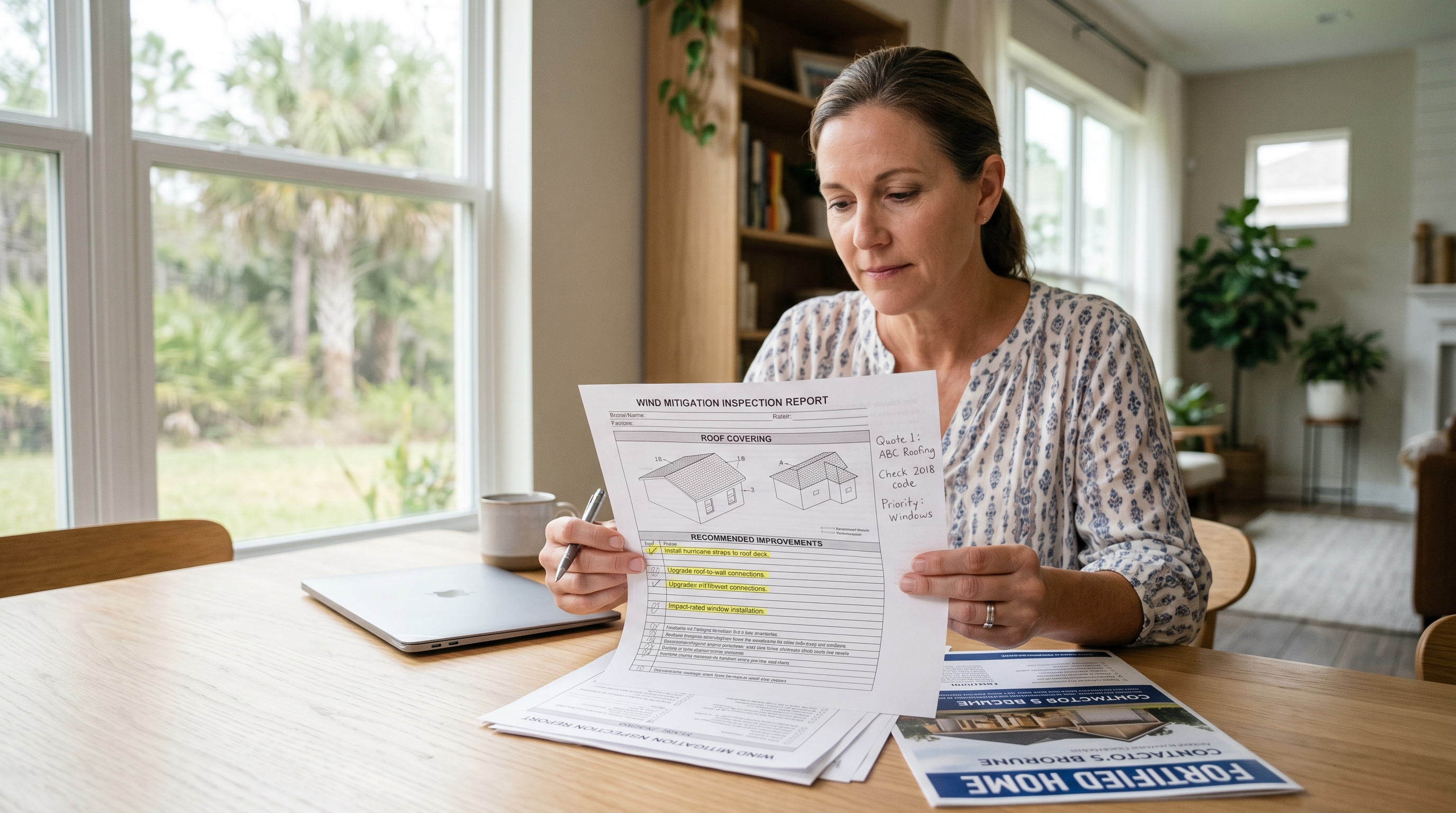
Do not forward the report to five contractors yet
When the initial inspection report arrives, many homeowners immediately forward it to contractors and ask for prices.
That is understandable, but it can create confusion.
Before you request quotes, spend a few minutes turning the report into a simple homeowner summary. You want to know what the report actually says before contractors interpret it for you.
Step 1: Save the full report
Save the full PDF in your project folder.
Do not rely on:
- Screenshots.
- A forwarded email only.
- One page from the report.
- A contractor’s summary of the report.
Use a simple file name:
2026-05-09-initial-inspection-report.pdf
Then create a note called:
inspection-report-summary.txt
Step 2: Find the recommended improvements
Look for the section that identifies recommended improvements.
You are trying to answer:
- Were any improvements recommended?
- Which categories were recommended?
- Are the recommendations about openings, roof-to-wall, roof deck, secondary water resistance, or a combination?
- Are there specific openings listed?
- Are there limits or notes?
If there are no recommended improvements, that changes your path. You may still choose to improve your home privately, but the grant-related path may not move forward the same way.
Step 3: Separate “recommended” from “wanted”
This is where many homeowners get tripped up.
You may want impact windows. You may want a new garage door. You may want a full roof upgrade. But grant-related eligibility depends on what the report recommends and what is later observed.
Create two lists:
Recommended by report: - [category] - [specific opening/area if listed]
Things I am considering separately: - [upgrade] - [reason]
This keeps the grant-related scope separate from your private wish list.
Step 4: Identify the contractor category
Different recommendations may require different professionals.
For example:
- Impact windows and exterior doors may involve window/door contractors.
- Garage doors may involve garage door contractors.
- Roof-to-wall, roof deck, or secondary water resistance may involve roofing or structural professionals depending on the work.
Do not assume one contractor is right for every recommendation.
Step 5: Write the quote request before calling
A clear quote request saves time.
Use this template:
Hi, I received an initial wind mitigation inspection report and want a quote for the recommended improvements.
The report appears to recommend: [insert category].
I would like the quote to clearly show: - Which openings or areas are included - Which are excluded - Product or system details - Permit responsibility - Timeline - Deposit and payment schedule - Completion documents I will receive - Contractor license number and legal business name
Can you provide a written quote with those details?
This tells contractors you are organized.
Step 6: Do not start work just because the report arrived
Receiving the inspection report is not the same as being cleared to start grant-related work.
The report gives you information. It does not automatically mean every project can begin immediately.
Before work starts, make sure you know:
- Whether you are inspection-only or grant-phase.
- Whether you need to submit a grant application.
- Whether contractor information has been submitted.
- Whether written approval has been issued.
- Whether permits are required.
If you are not sure, pause.
Step 7: Compare quotes against the report
When quotes come back, do not compare them only by total price.
Compare:
- Does the quote match the recommended improvement?
- Does it include all relevant openings or areas?
- Does it include non-recommended work that should be separated?
- Does the contractor explain permits?
- Does the quote include product details?
- Does payment timing make sense?
- Are documents at completion clearly listed?
Step 8: Decide whether you need help
You may not need a concierge if:
- Your report is simple.
- Your contractor is clear.
- Your quote is specific.
- Your timing is obvious.
- Your documents are organized.
You may want help if:
- The report is technical.
- Contractors are recommending different things.
- The quote is vague.
- You are not sure whether work can start.
- You are worried about reimbursement documents.
- You are helping a parent or relative manage the project.
CTA
Report arrived and you are not sure what it means?
Send it to us. We will turn it into a plain-English summary of what appears recommended, what questions to ask, and what to compare before you sign.
Primary CTA: Review my inspection report Secondary CTA: Prepare my quote request
Trust line: Independent guidance. Local contractor matching available. No grant, reimbursement, contractor, or insurance outcome guaranteed.