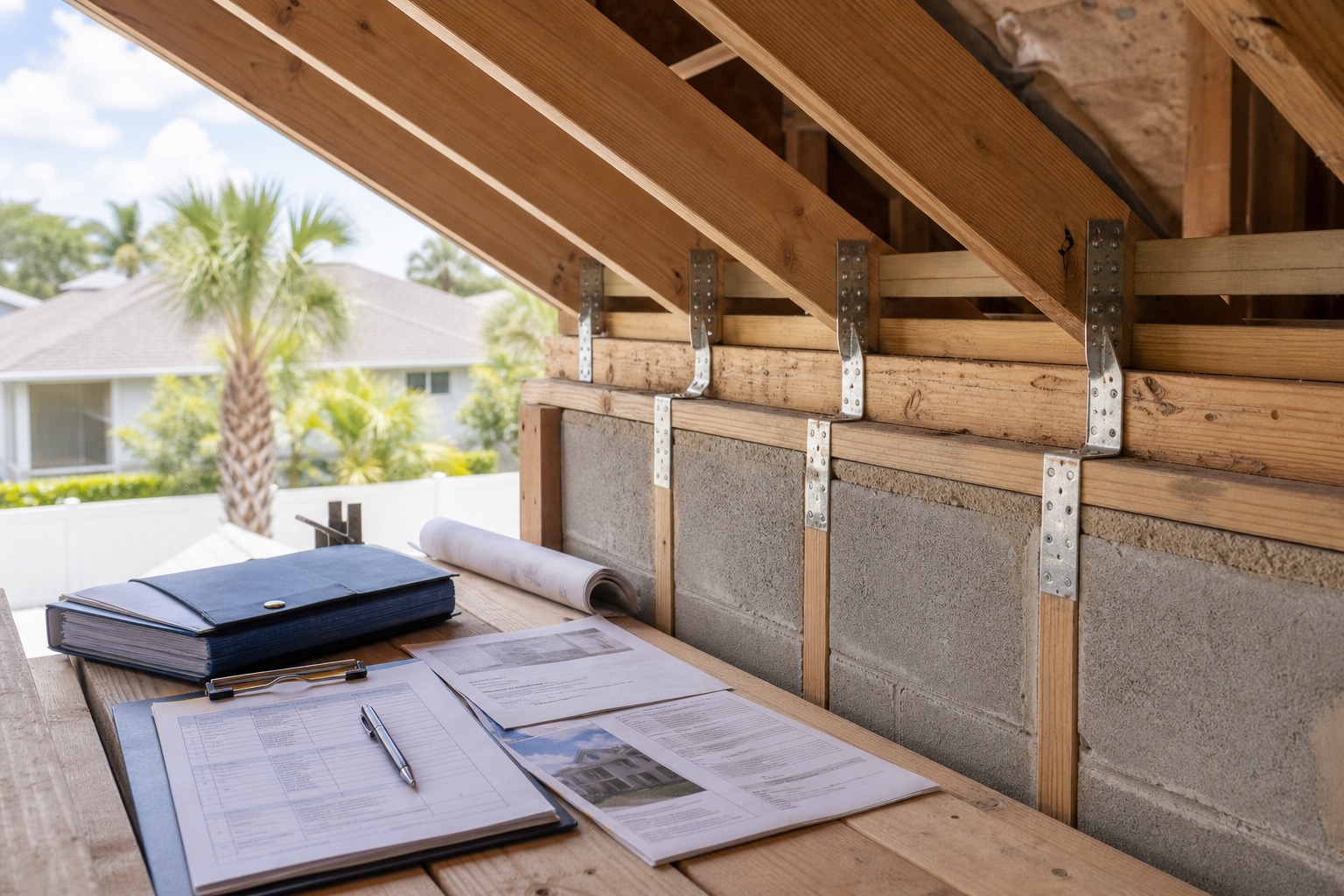
What roof-to-wall attachment means
Roof-to-wall attachment describes how the roof structure is connected to the walls of the home.
In plain English:
It is about helping the roof stay connected to the house when wind tries to lift it.
Homeowners may hear terms like:
- Toenails.
- Clips.
- Straps.
- Wraps.
- Anchors.
- Truss connections.
- Uplift resistance.
You do not need to memorize every technical term. You need to know what your inspection report says and what the contractor proposes to improve.
Why it is confusing
Roof-to-wall attachment is often hidden in the attic or behind finishes. Unlike windows or doors, you cannot always see the upgrade from the outside.
That makes documentation important.
A quote should explain:
- What existing condition was identified.
- What improvement is proposed.
- Where work will be performed.
- Whether attic access or finish work is involved.
- Whether permits are required.
- What photos or records will document completion.
Questions to ask the contractor
Use this script:
My inspection report mentions roof-to-wall attachment. Can you explain what condition was found, what improvement you recommend, where the work will happen, whether permits are required, and what documentation I will receive after completion?
Then ask:
- Will you provide before and after photos?
- Is the work accessible from the attic?
- Will any drywall, soffit, or exterior finish be disturbed?
- Is repair or repainting included?
- Is this work part of a larger roof project?
- Who handles local inspections?
Quote red flags
Slow down if:
- The quote says “roof straps” with no location or method.
- The contractor cannot explain how the inspection report connects to the quote.
- Finish repair is not discussed.
- Photos are not mentioned.
- Permit responsibility is vague.
- The contractor promises a specific insurance outcome.
What a strong quote includes
A strong roof-to-wall quote should include:
- Inspection-report reference.
- Proposed attachment method.
- Work location.
- Access requirements.
- Permit responsibility.
- Exclusions.
- Photos or completion documentation.
- Timeline.
- Payment terms.
- Warranty or workmanship language.
CTA
Does your report mention roof-to-wall attachment?
Send us the report and quote. We will help you turn the technical language into contractor questions before you sign.
Primary CTA: Review my roof-to-wall quote Secondary CTA: Explain my inspection finding
Trust line: Independent guidance. Local contractor matching available. No grant, reimbursement, contractor, or insurance outcome guaranteed.